

As we move further into November, Year 12 students are entering an important period of assessment and examination preparation. It is a busy time, and I know many students are juggling multiple subjects, assessment deadlines and the pressure of wanting to achieve their best.
1. Stop planning and start writing!
I often see students who have spent hours preparing essay plans, collecting quotations and making detailed notes, but have very little experience writing complete responses.

Planning is important, but at some point you need to put pen to paper (or fingers to keyboard!).
Writing complete drafts helps you identify where your arguments are unclear, where your analysis needs further development, and whether you can actually sustain your ideas across an entire response.
Don't just tell yourself you know what you would write. Actually write it!
2. Ask for feedback – and more importantly, use it!

I cannot stress enough how important feedback is.
When I mark student work, I am not simply looking for spelling mistakes or grammatical errors. I want students to understand how they can improve the quality of their analysis, develop stronger arguments, and communicate their ideas more effectively.
One of the biggest mistakes students make is receiving feedback, reading the comments, and then moving straight on to the next task.
Go back to your work. Look at the suggestions. Rewrite sentences, improve your analysis, and apply that feedback to your next response.
Improvement comes from acting on feedback, not just receiving it.
3. Practise under timed conditions

Writing an essay at home, where you have unlimited time to think, edit, and refine your work, is very different from writing one in an examination.
You need to know how quickly you can develop an argument, construct paragraphs and complete a response.
I encourage students to practise under realistic examination conditions. Put your phone away, set a timer, and complete the task without stopping.
You might not be happy with the first attempt, and that's perfectly fine. The purpose is to identify what you need to work on before the actual assessment.
4. Don't forget the fundamentals – form and context matter!
Something I regularly notice in student responses is that they become so focused on themes, techniques and quotations that they forget some of the fundamental elements of textual analysis.
Remember, you are not simply discussing what a text is about.
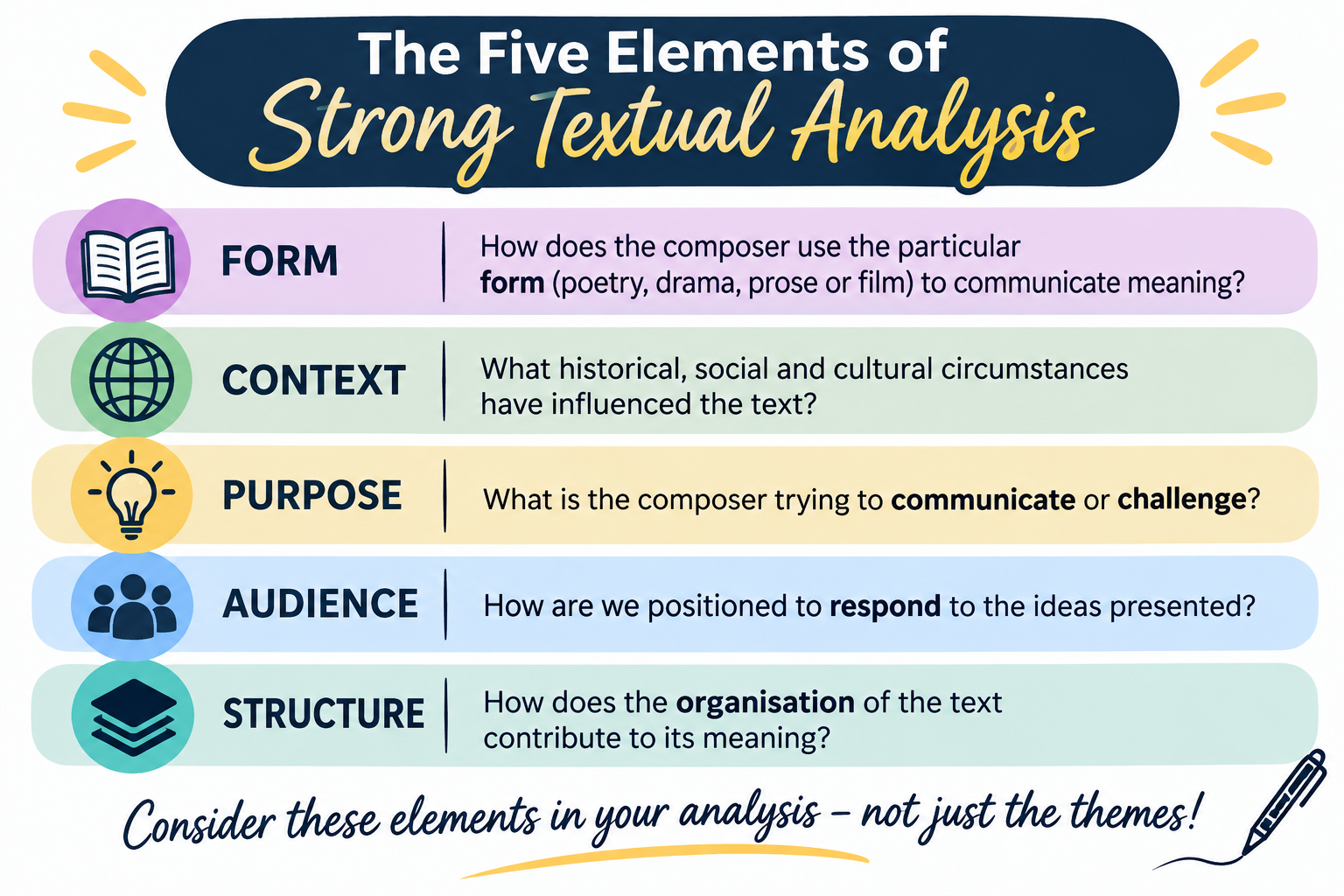
These elements should be woven into your analysis rather than added as an afterthought.

5. Work on your weaknesses, not just your strengths

It is tempting to keep practising the questions and topics you feel confident answering. However, this isn't necessarily where you will make the most progress.
If you struggle to integrate quotations, work on that. If your paragraphs tend to become descriptive rather than analytical, focus on developing your explanations. If you run out of time, practise writing more efficiently.
Be honest with yourself about what needs improvement.
A final reminder
Year 12 is a demanding year, and I know how much effort students put into preparing for their final assessments.
However, success in English isn't just about memorising quotations or knowing your prescribed text inside out. It is about being able to think critically, develop an argument and communicate your understanding clearly.
Use the time you have left wisely. Write those drafts, ask for feedback and practise under timed conditions.
A little more preparation now can make a significant difference when it counts!

